
Praying on the Streets: Russia’s Muslims Struggle for Space and Acceptance
Amid rising Muslim migration, public prayers in Russian cities have sparked resentment, revealing deep infrastructure gaps and growing intolerance
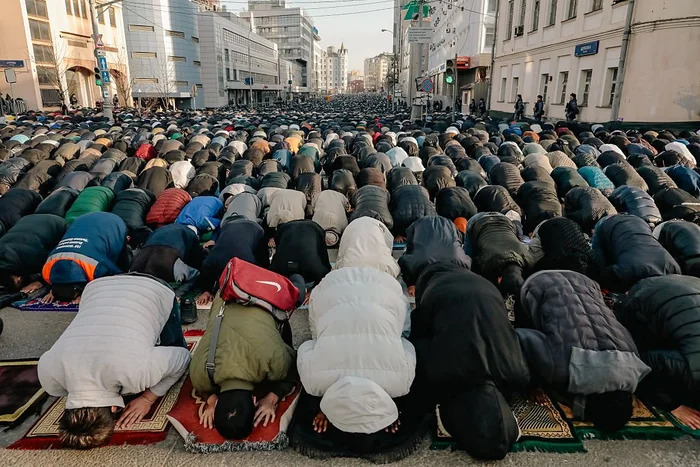
Russians are increasingly expressing anger toward Muslim migrants praying in public spaces — a tension rooted less in provocation and more in the country’s lack of mosques. Muslims, now estimated to make up 15 percent of Russia’s population — nearly 28 million people — say they simply have nowhere else to pray.
Across major cities like Moscow, St. Petersburg, Khabarovsk, and Vladivostok, videos have surfaced of Muslim bus drivers and taxi drivers praying near their vehicles or beside buildings.
One widely shared video from Khabarovsk showed a bus driver performing his prayers as passengers waited for nearly ten minutes. The regional transport ministry investigated but later cleared him, stating he had been on his legal break.
A similar case in Vladivostok ended with the driver being reprimanded and told to “show respect for the cultural and religious feelings of others” by finding “more secluded places to perform religious rituals.”
Valery Fadeev, head of the Russian Presidential Council for the Development of Civil Society and Human Rights, said, “While I’m not against Islamic prayers, I think it’s pretty weird when someone on the subway rolls out a prayer mat or a minibus driver starts praying.”
He added that many Central Asian migrants are unaccustomed to life in big cities and may not understand why praying in public feels unsettling to Russian urbanites.
Muslim workers, mostly from Uzbekistan and Tajikistan, say the problem is not choice but necessity. Islam requires five daily prayers, often during working hours.
“It draws attention and builds resentment toward migrants,” said a Tajik taxi driver named Daler. “I respect people’s right to religious freedom, but I think we shouldn’t add fuel to hostility toward migrants by praying where it inconveniences people.” He explained that drivers often pray “near buildings or rubbish bins” because reaching a mosque in time is impossible.
Russia has between 7,000 and 8,000 mosques — far too few for its growing Muslim population. Even in Moscow, often described as Europe’s largest Muslim city, mosques are overcrowded during Friday prayers and Islamic holidays, forcing thousands to pray on surrounding streets. Despite this visible devotion, the infrastructure to accommodate such numbers remains limited, reflecting broader social and political neglect.
Tensions have worsened since the March 2024 terrorist attack at Crocus City Hall, where four ISIS-linked gunmen killed 149 people and injured more than 600.
The aftermath saw heightened police raids and deportations of Central Asian migrants. In this climate, public prayers are increasingly viewed as provocative, with some incidents of violence reported against Muslims.
Rights activists warn that such hostility risks deepening discrimination. Russian human rights lawyer Valentina Chupik expressed concern that “this criticism is reinforcing stereotypes and potentially even fueling discrimination for the growing population of Muslims in Russia.”
For many Muslims, the issue is not defiance but survival — balancing faith with work in a society that remains uneasy with visible expressions of Islam. As one worshipper put it, praying on the street is “the only choice when there’s nowhere else to go.”
The growing frustration on both sides underscores a larger reality, an expanding Muslim population and a shrinking space for religious accommodation. Without structural and social reform — more mosques, and more understanding — Russia’s Muslims will continue to pray in public, and resentment will continue to grow in the streets beside them.
