
India’s Muslims Get Partial Relief as Supreme Court Puts Key Waqf Law Provisions on Hold
The top court’s interim order keeps mandatory registration of waqf properties in place but freezes rules on collectors deciding ownership, five-year practice requirements, and limits on non Muslim board members
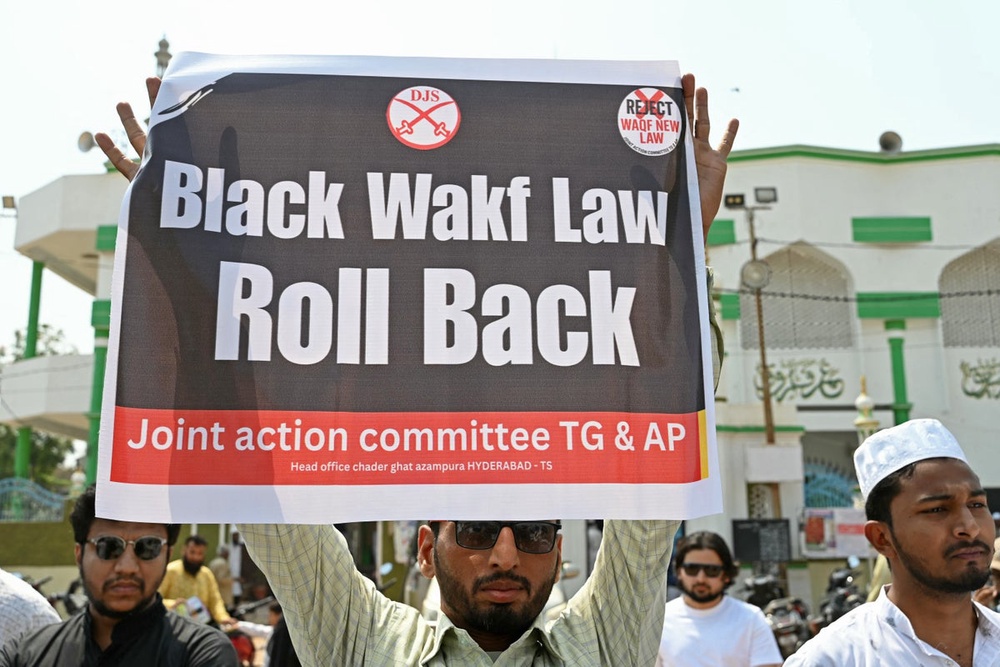
India’s Supreme Court has refused to block the Modi government’s new crackdown on Muslim charitable trusts but suspended some of the most controversial parts of the Waqf Amendment Act 2025. The law, passed earlier this year, rewrites how Muslim religious and charitable assets are managed under Indian law.
What Are Waqf Properties?
Waqf refers to religious or charitable endowments under Islamic law, often including mosques, graveyards, madrasas, orphanages and other community assets. Traditionally, these properties are managed autonomously by Muslim trustees for public benefit and are protected from sale or seizure.
India’s Waqf boards, set up under national legislation, supervise more than half a million such properties, making them one of the largest networks of Muslim charitable assets anywhere in the world. Changes to their regulation directly affect the daily religious and social life of millions of Indian Muslims.
The amendments mandate that every waqf property be entered on a centralised digital portal called Umeed (Unified Waqf Management, Empowerment, Efficiency and Development) with records, photographs and geotagged locations.
Any unregistered property can be marked “disputed” and referred to a tribunal. Previously, a waqf could be established by formal declaration, endowment after succession, or by long-standing religious use. Under the new law, only Muslims who have been practising Islam for at least five years and own the property may declare it a waqf.
Critics argue that the measure amounts to a state grab of Muslim assets. “The government says that disputed land will now be assumed to be government property, and it’ll be the collector’s decision. That’s against natural justice,” opposition MP Asaduddin Owaisi told reporters. “How can you be a judge in your own case?”
The Supreme Court bench led by Chief Justice B.R. Gavai stayed the provisions giving local collectors the power to decide ownership and update revenue records, calling such an arrangement a breach of the constitutional separation of powers.
It also put on hold the clause limiting waqf declarations to Muslims practising for at least five years until state-level rules are created to define adherence. Justice Gavai noted the rule was “not inherently arbitrary” but said enforcing it without clear mechanisms risked misuse.
Another flashpoint is the inclusion of non-Muslims in waqf management. The original law required all board members to be Muslim, including at least two women.
The amended Act lets state governments nominate lawmakers, judges and “eminent persons” from outside the faith. The court directed that the Central Waqf Council should have no more than four non Muslim members out of 20 and state waqf boards no more than three of 11, suggesting that chief executives should ideally be Muslim even though the law does not require it.
Muslim bodies have reacted with mixed feelings. Khalid Rashid Farangi Mahali of the All India Muslim Personal Law Board (AIMPLB) said, “Muslims and the AIMPLB wanted a stay on the entire Waqf (Amendment) Act, which the Supreme Court refused.
The court said the stay cannot be imposed on the entire Waqf law, but it put on hold certain provisions, which is a welcome step. We have got significant relief and hope to get complete relief when the final judgement comes.” He called the directive to appoint Muslim CEOs to waqf boards “a relief” but warned, “The issue of non-Muslim members (in the board) is still there … Waqf is an integral part of Islam.”
The All India Shia Personal Law Board (AISPLB) also expressed cautious optimism. Its general secretary, Yasoob Abbas, said, “We honour the judgement given by the Supreme Court … We have full faith in our courts, and we are hopeful of getting justice.”
But he added, “On the presence of non-Muslims in the Central Waqf Council and state Waqf boards as members, we request the honourable court to reconsider it.”
Government officials, meanwhile, hailed the ruling. Uttar Pradesh Minister of State for Minority Welfare Danish Azad Ansari said, “We welcome the Supreme Court judgement. The Modi government is honestly and seriously working for the upliftment and development of the minority Muslims and the Pasmandas.”
Former minister Mohsin Raza argued that the decision marks a defeat for petitioners and claimed, “Those who used to loot in the name of Waqf will now have hard times.”
Grassroots leaders voiced their unease about eroding autonomy. Samajwadi Party MLA Iqbal Mahmood questioned, “Such as the presence of non-Muslim members in the Waqf boards. Can we make any Muslim a member of the Ram Temple Trust?”
Bareilly cleric Maulana Shahabuddin Razvi called the judgement “very good” and “balanced.”
Behind the legal fight lies a deeper contest over religious freedom. India’s 200 million-strong Muslim community, 14.2% of the population according to the 2011 Census, sees the Act as undermining its constitutional right to manage its religious properties.
Senior advocate Kapil Sibal told the court, “It is the failure of the state to carry out their job from 1954 to 2025 and due to their failure, a community is being punished.” Other lawyers warned that removing “waqf by user” risks extinguishing properties recognised by oral tradition.
The government, however, defends the changes as necessary for accountability. Solicitor General Tushar Mehta argued that allowing “any person” to dedicate a waqf, as under the 2013 law, was conceptually flawed: “How can waqf, which is an Islamic concept, be available for non-Islamic persons?”
For now, the Supreme Court’s interim order leaves the core of the Waqf Amendment Act in force, especially mandatory digital registration, while halting the most contentious provisions. Both sides claim partial vindication, but the ruling also signals that India’s highest court recognises the sensitivity of balancing state oversight with the autonomy of one of the world’s largest Muslim communities.
