
Historic Shift in Indonesia’s Hajj Mission as Women Officers Reach 33 Percent
More than 500 female guides will assist Indonesia’s 221,000 pilgrims in 2026, responding to long-standing concerns about comfort, dignity, and women-specific needs during the sacred journey
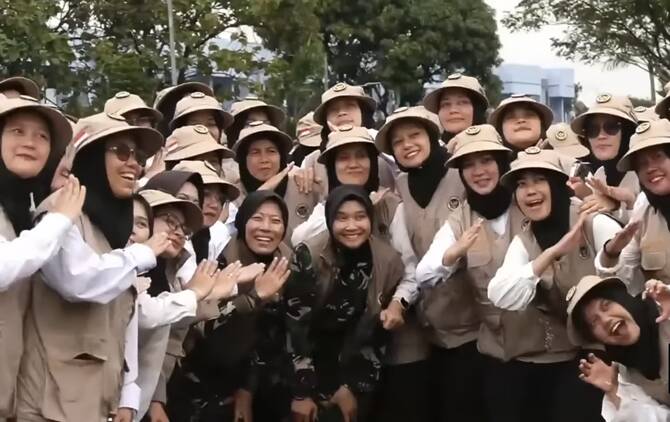
Indonesia is preparing for the 2026 Hajj with a historic shift in how it supports its pilgrims, by deploying the largest number of female Hajj officers the country has ever sent, a move aimed directly at improving care, dignity, and comfort for women and elderly worshippers.
After completing a 20-day intensive training program in East Jakarta, more than 1,600 Indonesian Hajj officers are now ready to assist the country’s massive pilgrim contingent of 221,000 people, the largest in the world. What stands out this year is that over 500 of these officers are women, making up roughly 33 percent of the total force, the highest proportion in Indonesia’s Hajj history.
“This year, women officers comprise about 33 percent, the highest in the history of Hajj management in Indonesia,” said Arifatul Choiri Fauzi, Indonesia’s minister of women’s empowerment and child protection.
The increase goes beyond meeting a target, it responds to the real makeup of Indonesian pilgrims themselves. More than 55 percent of those performing Hajj from Indonesia are women, many of them elderly, a group that often requires more personalized and sensitive assistance .
“There are many issues that are more suitable to be handled by female officers, things related to women’s issues, assistance inside the room, or emergencies that concern the privacy of the pilgrims,” Fauzi explained .
Listening to Past Concerns
For years, female pilgrims raised concerns about discomfort when seeking help from male officers, particularly regarding worship guidance and health matters. The Ministry of Hajj and Umrah says the expanded female presence is meant to directly address those experiences.
Deputy Minister of Hajj Dahnil Anzar Simanjuntak confirmed the new ratio even surpassed the ministry’s original goal.
“We want affirmative action for women because most of our Hajj pilgrims are women,” Simanjuntak said. “With a proportional number of female officers, a more personal and effective approach can be applied”.
He added that many women previously felt uneasy discussing sensitive issues with male guides.
“Female officers are needed to provide more humane, comfortable, and sharia-compliant services, especially for private matters and worship-related consultations,” he said.
The preparation program ran from January 10 to January 30 and covered physical readiness, Hajj regulations, Arabic language skills, communication training, and real-life simulations pilgrims commonly face during the journey. Additional online training will follow in February, along with region-based sessions closer to departure.
Puji Raharjo, director general of Hajj management, emphasized that the training is designed to prepare officers for both physical demands and human responsibility.
“This program is aimed at ensuring the physical, mental, technical and organizational readiness of the officers in order to guide, serve and protect Indonesian Hajj pilgrims,” Raharjo said.
Minister of Hajj and Umrah Mochamad Irfan Yusuf reminded officers of the weight of their role.
“Hajj officers fill a strategic role, you represent the state for the pilgrims, and you represent the state in front of the world,” he told the trainees.
Civil society voices have also welcomed the change, saying it reflects realities long ignored during Hajj operations.
Gusdurian Network Director Alissa Wahid called the expansion of female officers “a real and urgent need.”
“For female pilgrims, the increase in the number of female officers to 30 percent is a very positive step. In 2022 when I was part of the monitoring and evaluation team, the number of female religious guides and Hajj officers was still very limited,” she said during a training session in Jakarta.
Wahid described how shortages previously forced officers to improvise even in basic facilities.
“I often used some of the men’s bathrooms for female pilgrims at certain times. This is forced to be done because the number of bathrooms is the same, while the time and needs of female worshippers in the bathroom are longer,” she explained. “These improvised policies should be responded to systematically, not just as emergency solutions in the field”.
She also stressed the growing challenge of caring for elderly pilgrims.
“Services must be adjusted to the needs of elderly pilgrims so that worship runs smoothly, while reducing health risks, diseases, and deaths. All of this starts with the readiness and intention of the Hajj officers,” Wahid said.
Hajj on an Unmatched Scale
Indonesia’s Hajj operation is unlike any other in the Muslim world. With a population of around 240 million Muslims, the country holds the largest pilgrimage quota globally, 221,000 pilgrims for 2026 alone, while more than 5.5 million people remain on waiting lists that can stretch from 26 to 40 years in some regions.
The 2026 Hajj season is expected to fall between May 20 and June 2, during the month of Dhul Hijjah. Provincial quotas show East Java, Central Java, and West Java sending the highest numbers of pilgrims.
Against this massive scale, officials say strengthening human support,not just logistics is critical.
Simanjuntak noted that officers are trained to serve with empathy, especially toward the elderly.
“They are taught to treat elderly pilgrims as their own parents,” he said .
